Airbnb's new checkout rules: dishes and bed linen are back on the cleaner's list
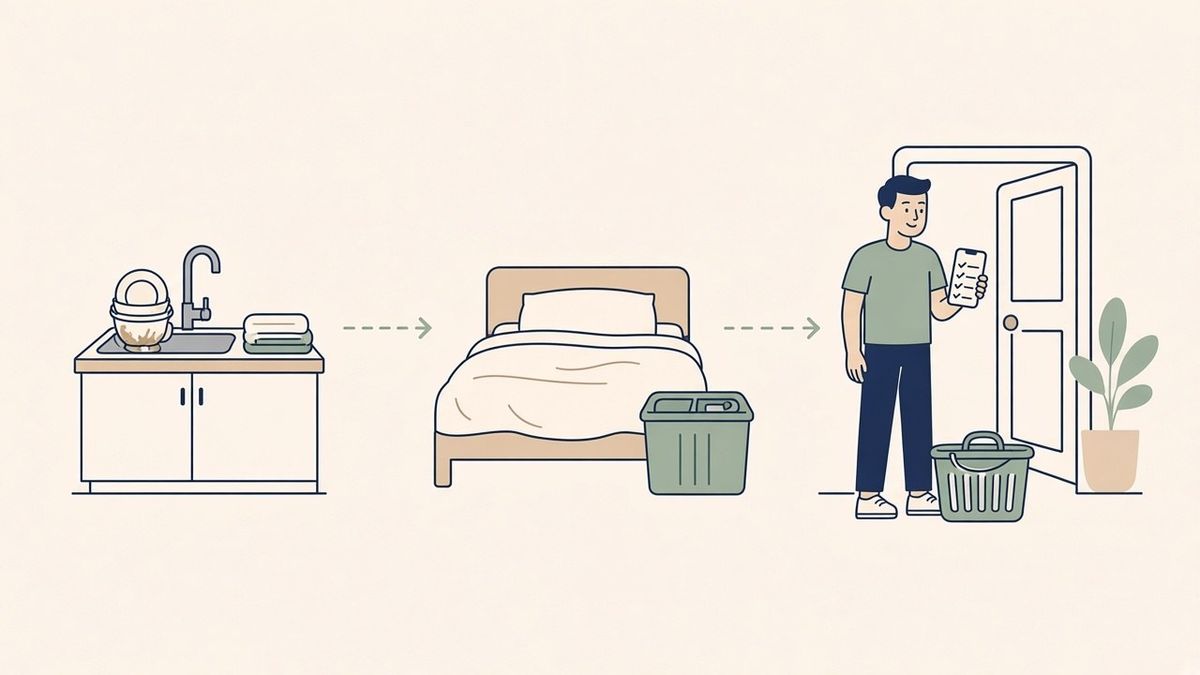
For years, a lot of listings ended with the same little list. Please run the dishwasher and strip the beds before you leave. Sometimes the bins had to go down too. Guests went along with it, more or less, and the cleaner walked into a half-tidied home.
For bookings made on or after 20 November 2026, that's over. Airbnb now puts these tasks on the side of whoever does the cleaning. Hosts get away with fixing a few lines in their listing. The cleaner's visit gets longer, and a property manager charging a flat fee should redo the maths before the first affected checkouts.
What Airbnb still allows
Requests have to be "reasonable". Airbnb gives fairly precise examples in its Resource Center article.
In practice, the cleaner can still count on a guest who leaves dirty dishes in the sink rather than on the terrace table, puts wet towels in one place, uses the right kitchen bins and turns off the air conditioning. Everything else is theirs: the washing-up, stripping the bed, starting the laundry, carrying the bags down.
Host-set fines are gone as well. The only option left is to mention, at the bottom of the house rules, a fine that local authorities or the homeowners association could charge.
And the rules have to be in the listing at the time of booking. Airbnb's help page rules out anything added afterwards, by message, by a sign or in person. Watch out for old team habits: a cleaner who leaves a note on the table saying "please strip the bed before you go" is, without meaning to, creating a rule that isn't in the listing. In the listing editor, the checkout instructions section is gone. Locking up joins the standard rules; everything else goes into Additional rules, under Before checkout.
Listing reviews start on 20 November and run until March 2027. If a rule doesn't fit, the host gets at least 20 days to change it or appeal, with supporting documents such as building rules. Exceptions are still possible depending on the home or local laws, but each one will have to be argued.
What lands on the cleaner's plate?
Take a one-bedroom flat with a same-day turnover. Until now, the cleaner often found the bed already stripped, the sheets in a heap by the door, the dishwasher running. Now expect the opposite. The bed is as the guest left it. The dishes are waiting in the sink, at best. Full bags sit under the sink, and the cleaner is the one carrying them down to the bin store.
None of these tasks takes long on its own. Added up, they do, especially in a place that sleeps six. We won't give you a number, because it depends on the home and how far the bins are. The most reliable approach is to time a few turnovers after 20 November.
The checklist, the time slot, then the price
Start with the checklist. If it was written assuming the guest would pitch in, it has gaps. Spell out stripping the beds and starting the machine, washing and putting away the dishes, taking the bins down. Make those tasks required, or they'll get skipped on a busy day.
Then the time planned per job. A slot sized back when the bed was already stripped is probably too tight now. If your cleaner is paid a flat rate, they absorb the difference. Sooner or later they'll tell you. Or leave.
Finally, price. The cleaning fee shown to guests and what you pay the cleaner need to be reviewed together. The argument comes up a lot in the press: guests already pay a cleaning fee, so they shouldn't have to clean. Your rate might as well match the real workload.
Rules that save the cleaner time
Since guests won't do the heavy lifting any more, their small gestures might as well be useful to the cleaner. A few examples written from the cleaner's point of view:
- Before: "The bed must be stripped at checkout." After: "Please leave used towels in the shower, that's where the cleaner starts."
- Before: "Dishes clean and put away, thanks." After: "Dirty dishes go in the sink, not on the terrace or in the bedrooms."
- Before: "Bin bags to be taken to the ground-floor bin store." After: "Glass in the small separate tub, everything else in the kitchen bin."
- Before: "Extra cleaning charge if the kitchen is left dirty." After: nothing, the line goes.
The automated pre-checkout message can repeat what is in the listing, and Airbnb even provides a quick reply that pulls in your rules. It can't add anything.
What Calensi takes care of
Calensi doesn't touch your listing. On the cleaning side, though, it absorbs a good part of the change.
Cleaning jobs are created automatically from bookings, between each checkout and the next check-in, and updated if a stay is cancelled or moved. Each property has its own checklist. You start from a template, add "strip the beds and start a wash", and required tasks must be ticked before the job can be completed. A backup cleaner discovering the place gets exactly the same list as your regular one.
At the start, the cleaner takes arrival photos, timestamped by the server rather than the phone. If a home is left in a state that goes beyond reasonable, these are timestamped photos that help build your case; the platform decides. The details are in our article on deposit disputes.
For the turnover itself, see Turnover cleaning between guests. And to pick a tool, our housekeeping software comparison puts them side by side.
20 November is only days away. Reread the Before checkout section of your listing, then take a moment with your cleaner to go over the checklist. That's where it really plays out.