Why Your Apartment Should Never Have the Same Price on Airbnb and Booking.com
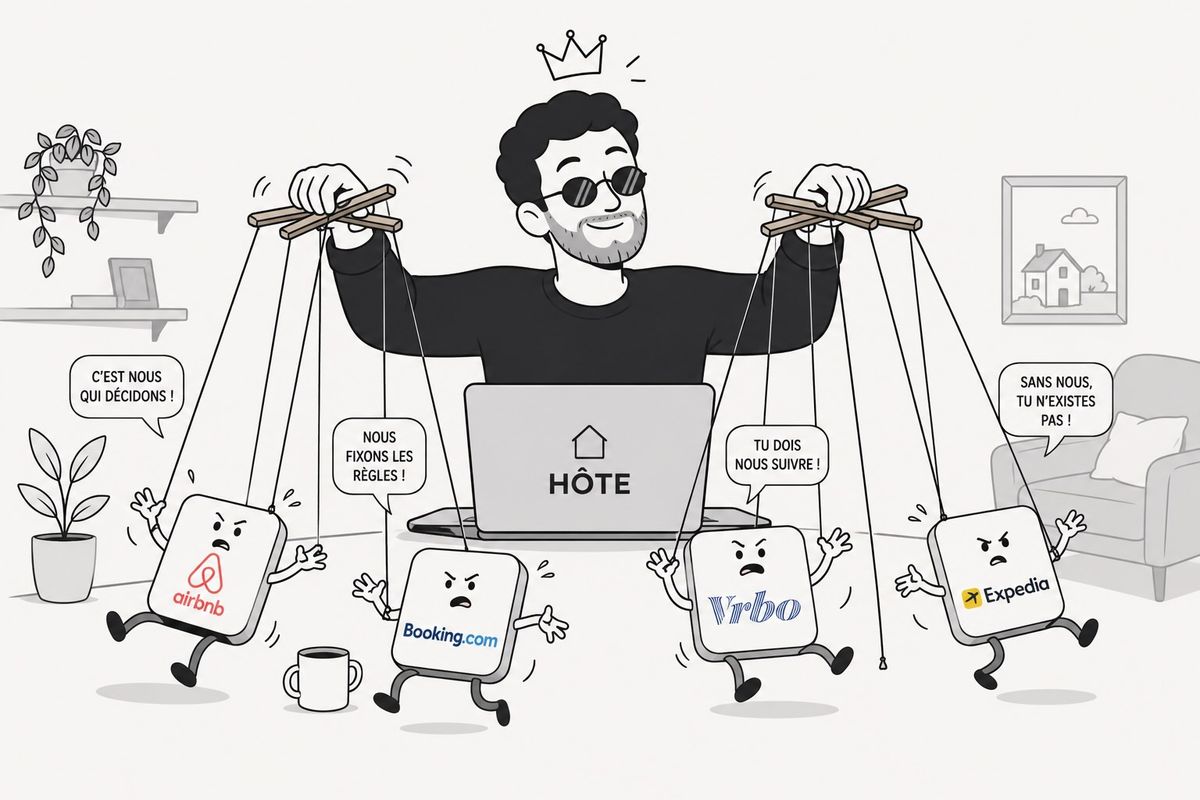
Many hosts assume that the same apartment should have the same price everywhere.
In reality, Airbnb and Booking.com attract different travelers, with different behaviors and different costs.
Owners who apply a single rate across all platforms often leave money on the table.
The key difference few hosts actually measure
| Criterion | Airbnb | Booking |
|---|---|---|
| Advance bookings | High | Medium |
| Last-minute bookings | Medium | Very high |
| Business travelers | Low | High |
| Price sensitivity | Medium | High |
| Cancellation rate | Low | Higher |
The key insight:
The same property is not being sold to the same customer
Airbnb is often a value-enhancement engine. This difference can sometimes justify a price gap of 5 to 15%.
Example: an apartment in Nice in July
| Platform | Nightly rate |
|---|---|
| Airbnb | €180 |
| Booking | €165 |
Let's assume:
- Airbnb: 20 nights sold
- Booking: 8 nights sold
Result:
| Strategy | Revenue |
|---|---|
| Flat rate €170 | €4,760 |
| Differentiated pricing | €4,920 |
+€160 in a single month.
Over a full year, the gap becomes significant.
The strategy of experienced hosts
Many use:
Airbnb = premium rate
- better photos
- leisure travelers
- longer stays
- fewer cancellations
Booking = aggressive rate
- filling vacancies
- last minute
- business travelers
- occupancy rate optimization
The goal is not:
to maximize the price
but rather:
to maximize overall revenue.
This is a fundamental distinction.
The mistake made by automated pricing tools
Most dynamic pricing systems look at:
- the season
- local events
- competition
But few hosts think about the real value of each acquisition channel.
An Airbnb booking at €180 doesn't necessarily have the same value as a Booking reservation at €180.
Acquisition costs, cancellations, and traveler behavior are all different.
Should you then manage prices manually?
For a single property: Maybe.
For multiple properties: No.
Modern channel managers allow you to apply markups or discounts per platform.
Tools like Beyond Pricing can even automatically adjust rates based on market demand.
The hidden problem: losing control of your channels
When prices, bookings, and operations are scattered across multiple platforms, it becomes difficult to understand what is actually generating revenue.
Many hosts know their Airbnb or Booking revenue figures.
Few know:
- which channel is the most profitable;
- which generates the most work;
- which creates the most guest turnovers.
This is precisely where a tool like Calensi becomes valuable:
- calendar centralization;
- turnover visualization;
- operational control independent of platforms;
- ability to change pricing strategy without disrupting cleaning operations.
In conclusion
The question is not: Should I have the same price everywhere?
The real question is: What role does each platform play in my strategy?
The best hosts don't use Airbnb and Booking as carbon copies of each other. They use each platform for what it does best:
- Airbnb to maximize value.
- Booking to fill vacancies.
And they maintain control of their operations through their own tools rather than depending entirely on OTAs.